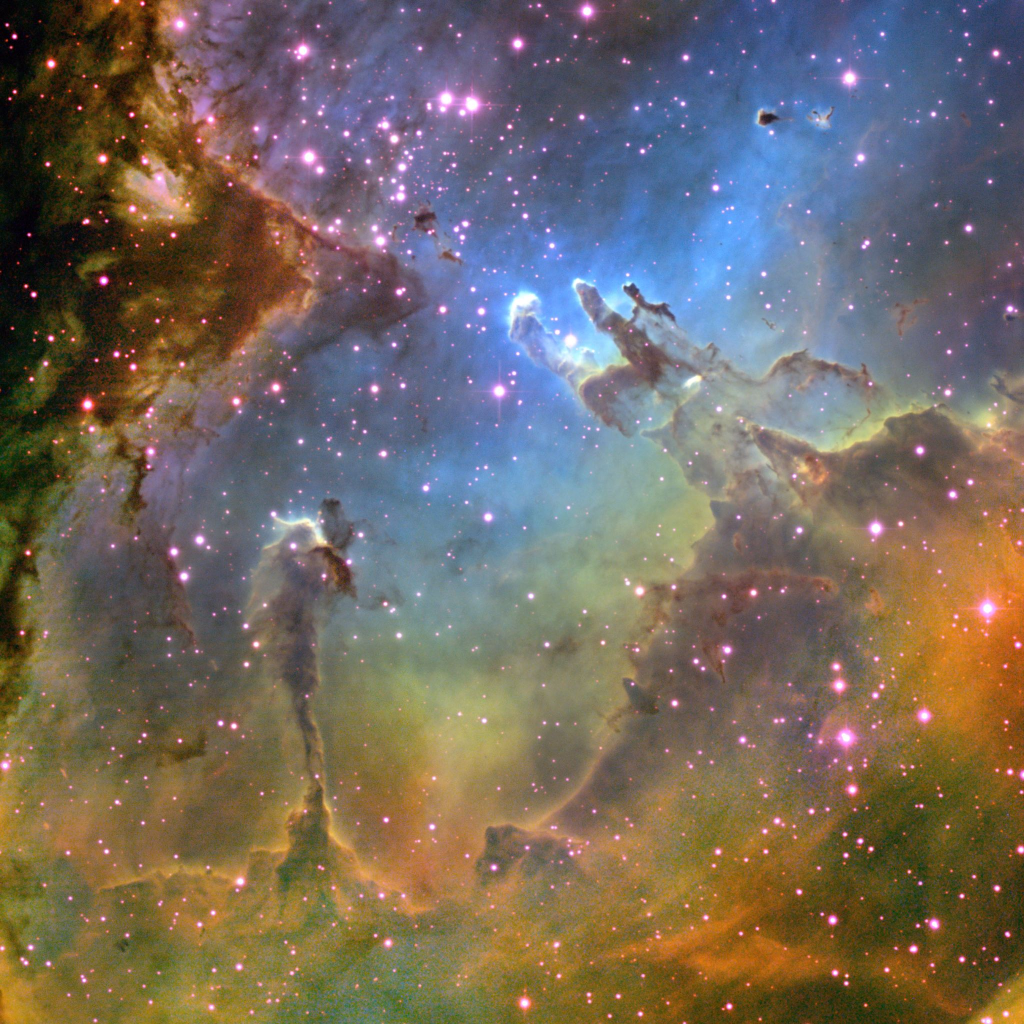
Image Credit: T.A.Rector (University of Alaska Anchorage, NRAO/AUI/NSF and NOAO/AURA/NSF) and B.A.Wolpa (NOAO/AURA/NSF)
Young Stars and Planets
Dr. Wood’s research focuses on young stellar associations and the stars and planets within them, with a particular specialty on measuring stellar ages.
What is a Stellar Association?
Stars do not form alone, but in large groups, sometimes called stellar nurseries. When a giant cloud of molecular hydrogen collapses, dozens or hundreds or thousands of stars will all form at the same time, collecting in pockets of over dense gas.
The results of these stellar nurseries are stellar associations. Associations may be tightly grouped or spread out across large swaths of the galaxy. Most associations will break up over hundreds of millions of years, so surviving associations are typically young.
Because stellar associations are large populations of stars that all formed in the same time and place, they provide a great examples of how stars with the same starting conditions but different masses evolve over time.
Publications
A Tale of Two Stars: SU Auriga and AB Auriga
SU Auriga and AB Auriga are two young stars in the Taurus-Auriga stellar association which have slightly different masses. We used multi-wavelength observations spanning more than 20 years in order to study how these young, evolving stars change over time, finding remarkable stability over that period, and new insights into the stars’ structure.
Why It’s Cool: The first few million years of a star system’s existence are very important for determining what the system will look like, including the prospects for life. But, young stars change rapidly and small differences in mass can put them on very different paths. By looking at these two stars with slightly different masses over a long period of time we can gain understanding of how they are different from each other and how conditions for life might fare on potential planets around each.
How We Did It: We gathered archival data from multiple telescopes, including the X-ray space telescopes Chandra and XMM-Newton, and ground-based optical telescopes. We then reanalyzed all of the data consistently and compared the data to models of stars to determine properties like element abundances, temperature and flaring activity.
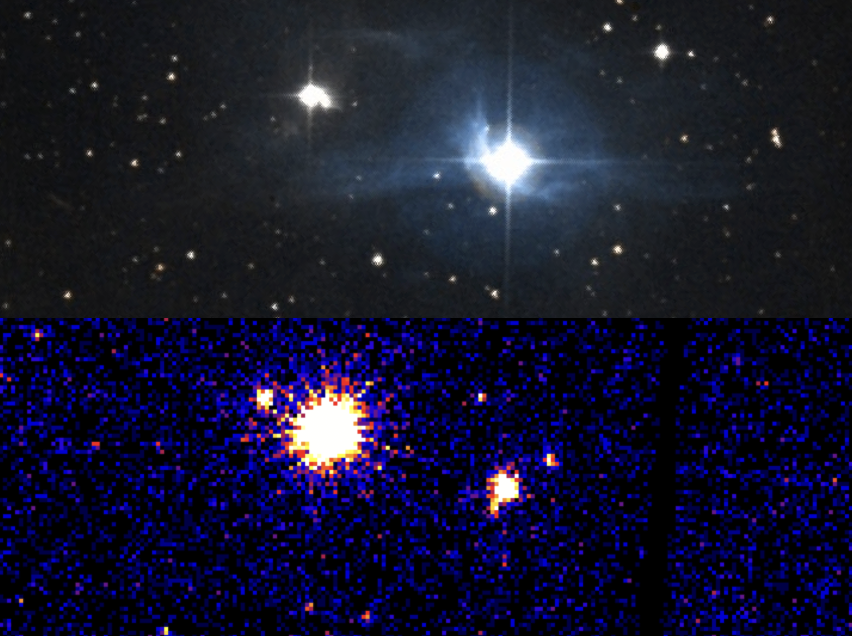
HD 109833 & Melange-4
We discovered, censused, and measured the age of the new stellar association MELANGE-4, and found two planets orbiting the candidate member HD109833. The association is 27 million years old, and has over 300 members, at least four of which are known planet hosts.
Why It’s Cool: This new association is a whole new sample of stars to study, that is both at the right age to look at some critical changes, and nearby, making it easy to observe in detail. It also contains several planets, which we now know the age of, allowing astronomers to see how planets at 27 million years old are different from 5 million year old or 500 million year old planets.
How We Did It: We used new telescope surveys like the European Space Agency’s Gaia mission, and NASA’s TESS to gather information about the stars in the associations. Computational techniques like bayesian probability analysis help to identify the association even when the members have spread out across the galaxy. We used ground-based telescopes to follow-up on members and measure the Li content to determine the age.